Vertis 2.0
A Natural Language Interface for enterprise workforce and workplace teams to query their own data and get grounded, numeric answers.
Head of Product & Design • Enterprise SaaS • AI/NLI • MVP shipped in 6 weeks
Overview
Role: Head of Product & Design (sole owner)
Users: HR, Chief of Staff, Recruiting, Office/Facilities
ICP: Enterprises with 3,000+ employees
Team: Distributed engineering (US + Europe)
Timeline: MVP shipped in 6 weeks (incl. testing + holidays)
Launch: Rolling out to current customers first (launching January 2026)
What I owned
I ran the full product cycle end to end:
- Owned product strategy and roadmap sequencing (2.0 → 2.1+)
- Defined MVP scope and made tradeoffs under a compressed timeline
- Led end-to-end UX/UI for the NLI experience
- Designed AI interaction patterns (clarification loops, error handling, low-confidence behavior)
- Built a functional prototype in Replit (CSV ingestion, persona selection, Gemini API, prompt logic, chat saving)
- Ran delivery cadence: Monday sync + async standups + decision logs + Friday demos
Context and strategic trigger
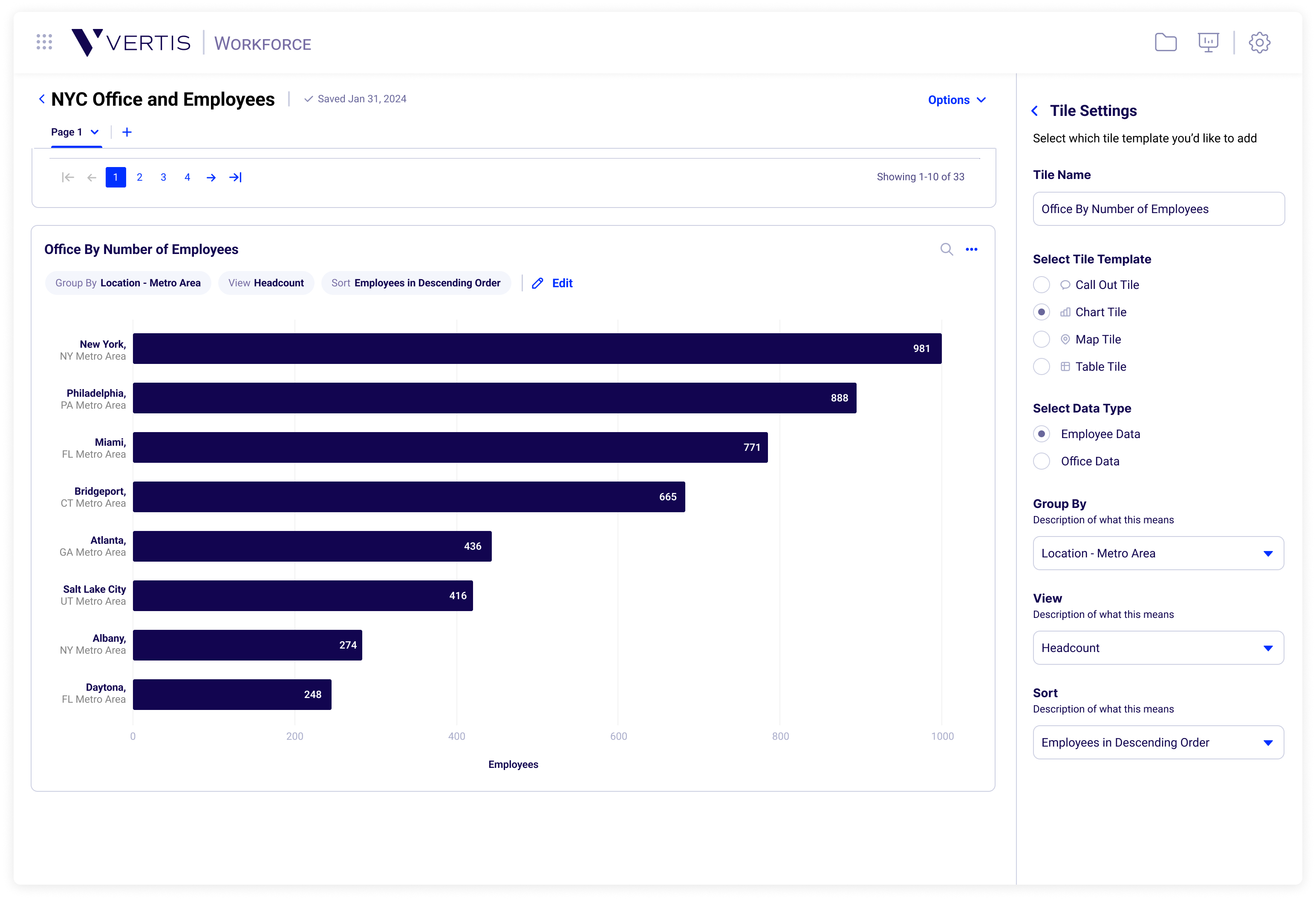
Vertis supports enterprise workforce and workplace management by enabling teams to make decisions about people and places with improved operational efficiency.
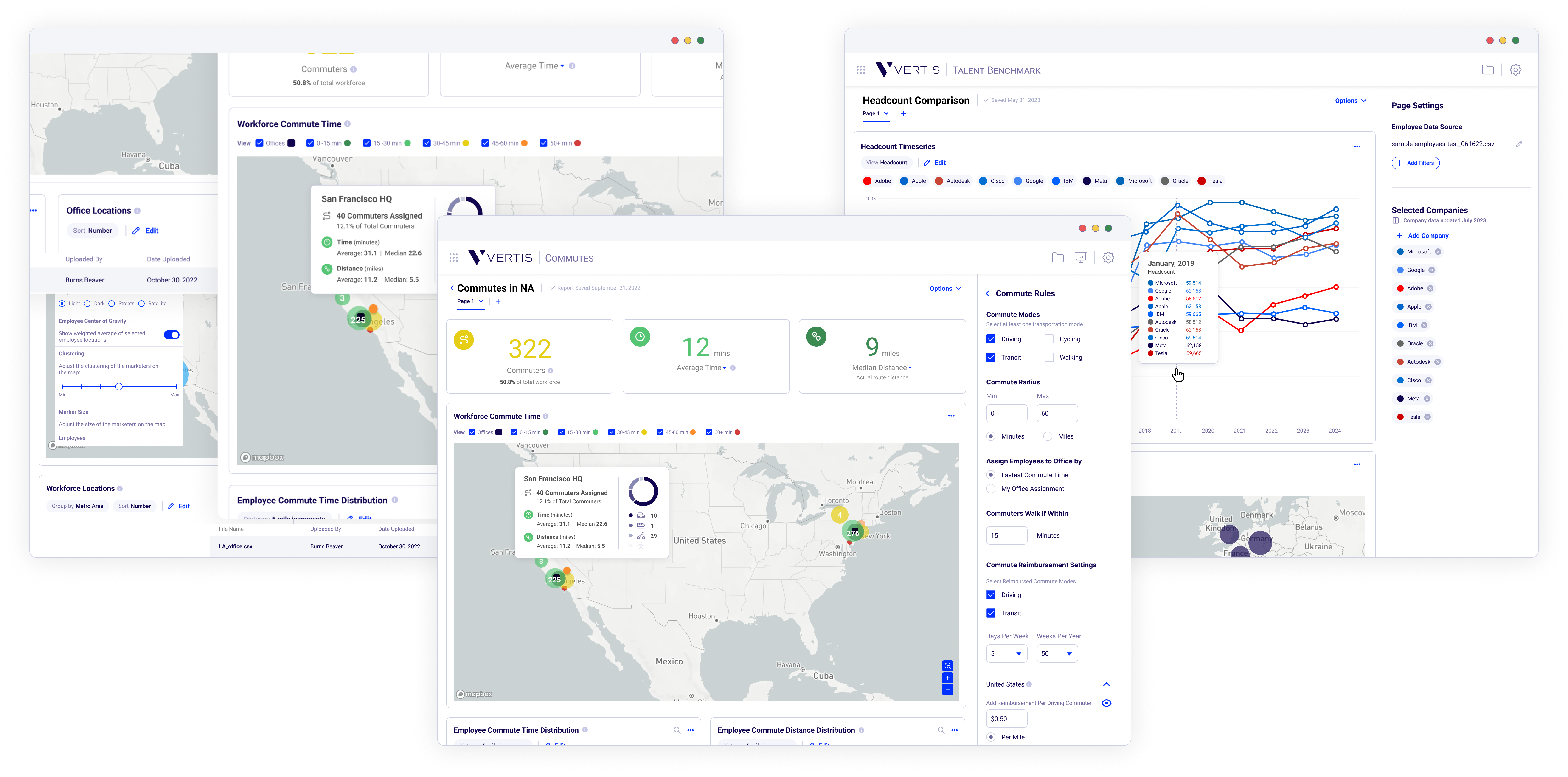
Following an executive transition (CEO departure; President/Head of Sales assuming the CEO role), the product strategy shifted from static dashboards to a Natural Language Interface. This change was driven by a need to provide customers deeper, self-serve access to their own data—without relying on the product team to build additional visualizations—particularly as organizations navigate evolving workplace dynamics (RTO, hybrid policies, and utilization variability).
Strategic intent: Increase self-serve depth of analysis while maintaining continuity with V1 capabilities.

Goals and product principles
Product Goals
- Improve user activation by enabling immediate, secure interaction with customer data.
- Reduce time-to-value by returning answers without dependency on new dashboards or filters.
- Strengthen retention within a seat-based model through increased day-to-day usability.
MVP principle
In Vertis 2.0, a “useful answer” is defined as a numeric output derived from the uploaded dataset. More advanced capabilities (prediction and scenario planning) are reserved for subsequent releases.
Delivered scope (V2.0)
Included
- NLI-first experience replacing the previous V2 product paradigm
- User-scoped CSV ingestion for customer-provided datasets
- Workforce and Workplace shipped concurrently to preserve V1 value
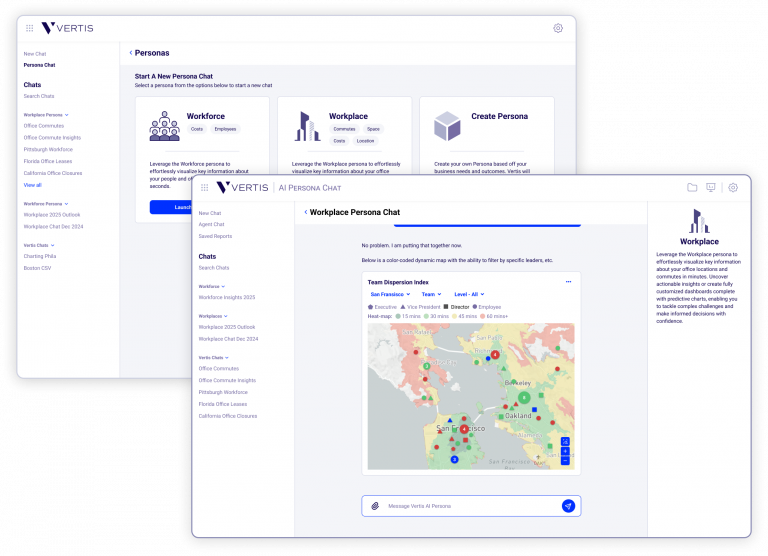
- Persona-based modes to guide domain-specific questioning (Workforce / Workplace)
- Project-based chat persistence (Workforce/Workplace projects aligned to V1 dashboard saving)
- Session logging across chats to support tuning and iteration
Deferred
Workday integration (V2.1)
Benchmarking (V2.1; data readiness required)
Predictive analytics (backlog)
Scenario builder (backlog)
Collaboration/shareability (roadmap)
Confidence scoring UI (backlog)
Experience overview
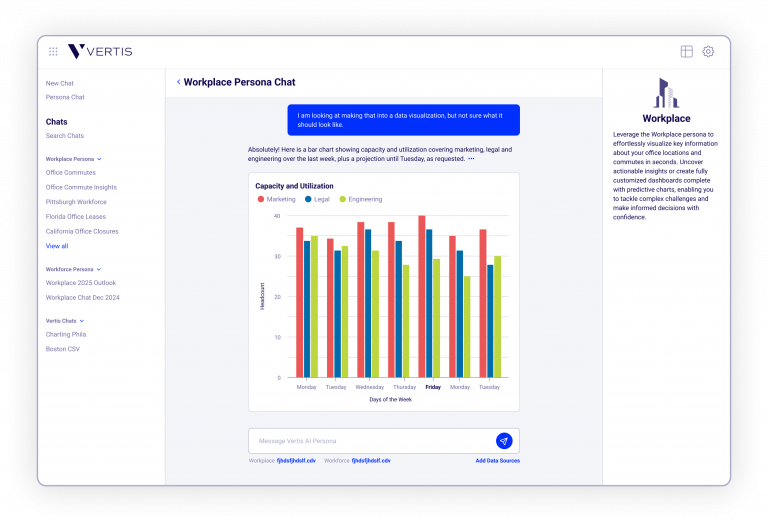
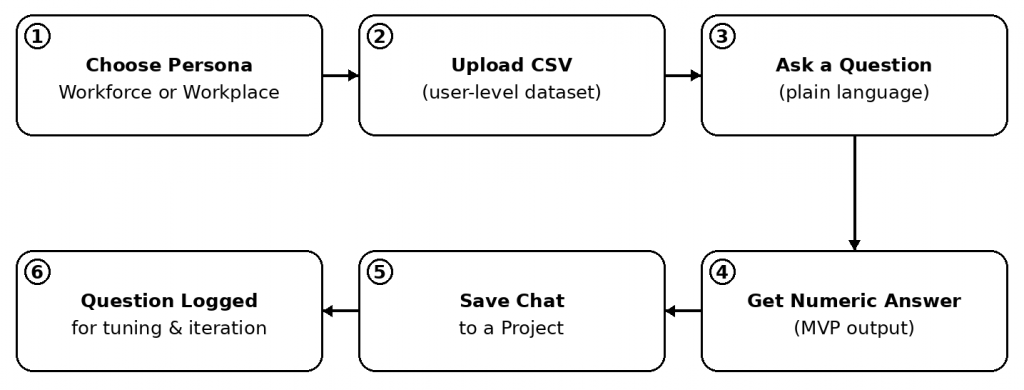
The primary workflow is: persona selection → CSV ingestion → natural-language query → numeric response → project-based persistence → session-level logging for ongoing improvement.
Differentiation: domain-guided personas
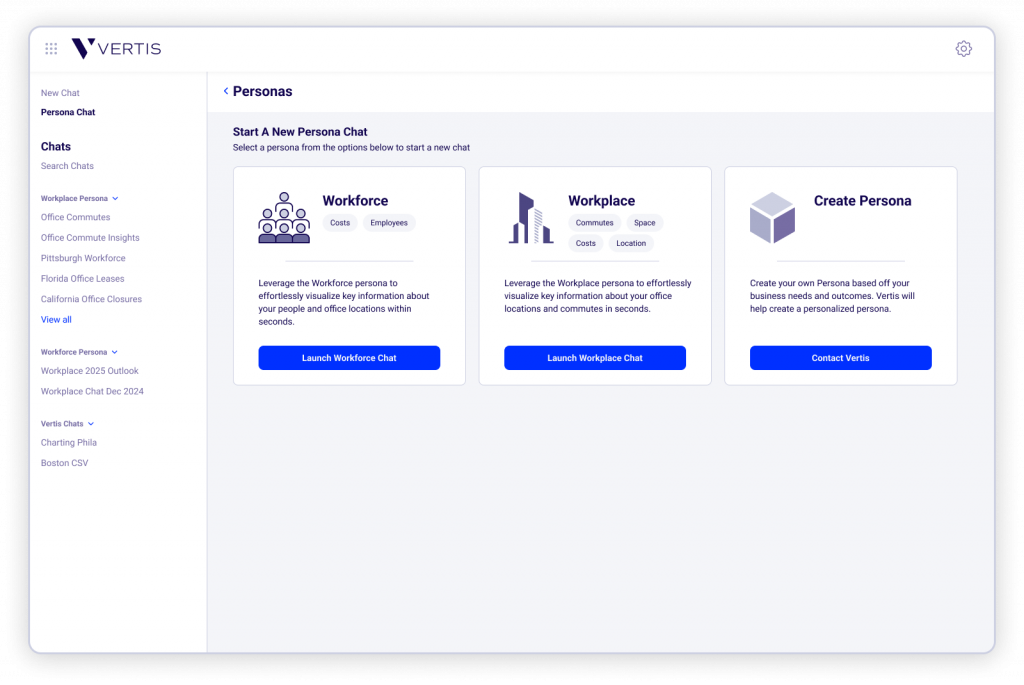
Most AI chat experiences are general-purpose. Vertis 2.0 uses personas as domain-guided expert modes for Workforce and Workplace. This reduces prompt burden, improves consistency, and creates a surface area we can tune over time.
Workforce persona
Best for: headcount, recruiting, workforce distribution.
MVP output: numeric answers from uploaded CSVs.
Workplace persona
Best for: footprint, location planning, utilization.
MVP output: numeric answers from uploaded CSVs.
Trust, failure modes, and recovery
Trust is built in edge cases. I created an error matrix and designed recovery behavior so users understand what’s happening and what to do next.
Recovery patterns
Ambiguous question → ask a clarifying question
Missing data → request required fields or a new upload
Low confidence → avoid absolutes (“seems to suggest…”) and guide refinement
System/API errors → show warning states and recovery guidance
Built as a learning system
Vertis 2.0 logs every question a user asks across chats. This gives us a direct feedback loop to tune persona behavior, improve recovery UX, and prioritize roadmap items based on real customer language.
What session logs enable
Identify recurring question patterns per persona
Detect missing fields and unclear mental models
Improve prompts and response formatting
Prioritize what to build next